Standard Countertop Edge Profile Dimensions
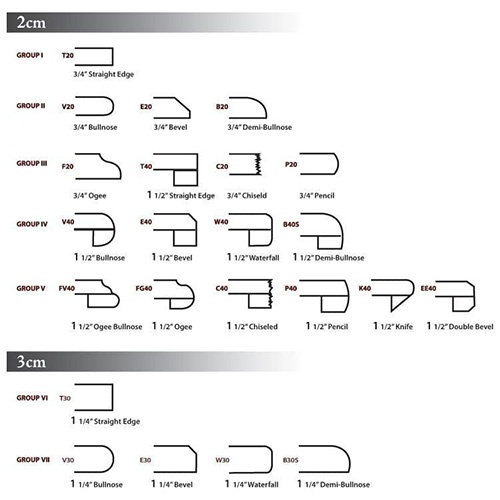
When specifying a granite, quartz, quartzite, marble, or solid-surface countertop, the edge profile dimensions should be included in the fabrication specification. The edge profile affects the finished appearance, exposed thickness, comfort, cleaning, and how the countertop integrates with cabinets and other architectural elements.
There is no single universal dimension for every countertop edge. Actual measurements vary according to the material, slab thickness, fabrication equipment, manufacturer, and design requirements. However, several dimensions are commonly used as starting points for residential, commercial, and hospitality countertop projects.
Common Countertop Edge Profile Dimensions
| Edge Profile |
Typical Edge Detail |
Common Application |
| Eased Edge |
1–3 mm corner radius |
Modern kitchens, hotels |
| Small Bevel |
6–12 mm bevel |
Contemporary countertops |
| Large Bevel |
15–25 mm bevel |
Decorative modern designs |
| Half Bullnose |
10–20 mm radius |
Kitchens, vanities |
| Full Bullnose |
Approximately 15–20 mm radius |
Traditional interiors |
| Ogee |
Approximately 20–40+ mm profile depth |
Luxury/classic interiors |
| Mitered Edge |
45° joint; commonly 50–100+ mm visual thickness |
Islands, feature counters |
| Waterfall |
45° miter at island corner |
Modern kitchen islands |
These are typical fabrication ranges rather than universal standards. A countertop fabricator should confirm the exact dimensions before production.
Eased Edge Dimensions
The eased edge is one of the simplest countertop profiles. Instead of leaving a sharp 90-degree corner, the exposed corner is lightly softened.
A small radius of approximately 1–3 mm is commonly used for a clean contemporary appearance. Some fabricators may use a slightly larger radius depending on the material and equipment.
Eased edges are particularly suitable for granite and quartz countertops in modern kitchens, hotel vanities, restaurant counters, and commercial spaces because the simple profile is easy to clean and visually unobtrusive.
Beveled Edge Dimensions
A beveled countertop edge introduces an angled section rather than a rounded transition.
Small bevels commonly measure around 6–12 mm, while larger decorative bevels may extend approximately 15–25 mm or more. The exact size should be coordinated with countertop thickness and the desired visual effect.
A small bevel creates a subtle highlight, while a larger bevel becomes a more obvious architectural feature.
Bullnose Edge Dimensions
A bullnose profile creates a rounded countertop edge. Half bullnose and full bullnose profiles are the two common variations.
For a half bullnose, the curved portion may extend approximately 10–20 mm, depending on the countertop thickness. A full bullnose can use a larger radius designed to create a continuous rounded edge.
Rounded profiles are frequently specified for bathroom vanities, kitchen islands, hotel guestroom counters, and traditional interiors.
Ogee Edge Dimensions
The ogee edge is more decorative than eased or beveled profiles. Its S-shaped contour can extend approximately 20–40 mm or more across the edge, depending on the tooling and countertop thickness.
Because the profile contains multiple curves, the final dimensions should be confirmed with the fabricator using a profile drawing or sample.
Ogee edges are generally associated with traditional, transitional, and luxury interiors rather than minimalist modern kitchens.
Mitered Edge Dimensions
A mitered countertop edge is different from a simple routed profile. Two pieces are cut at approximately 45 degrees and joined to create the appearance of a thicker slab.
A standard 20 mm or 30 mm stone countertop, for example, can be fabricated with a mitered build-up edge to create a visually thicker 50 mm, 60 mm, 75 mm, or 100 mm appearance, depending on the project specification.
This technique is popular for kitchen islands, reception counters, restaurant bars, and luxury hospitality interiors.
Countertop Thickness and Edge Profiles
The countertop thickness must be established before selecting the edge profile. Common natural-stone countertop thicknesses include approximately 20 mm and 30 mm, although other thicknesses and laminated build-ups are possible.
A decorative profile cannot simply be selected independently of slab thickness. The fabricator needs enough material to safely create the desired curve, bevel, or mitered construction.
Recommended Specification Information
For a countertop RFQ or fabrication drawing, include:
- Countertop material and stone name
- Slab thickness
- Overall countertop dimensions
- Edge profile name
- Exact edge dimensions or profile drawing
- Sink and faucet cutouts
- Backsplash dimensions
- Corner radius
- Mitered or waterfall requirements
- Surface finish
- Seam locations
- Finished edge locations
For hotel, resort, restaurant, and commercial projects, Newspace Hospitality can coordinate custom countertop fabrication according to drawings, BOQ requirements, material specifications, edge profiles, dimensions, and project standards.








 Mail inquiry
